Showing posts with label Film Review. Show all posts

Thursday, 21 January 2016

Film Review: Paprika (2006)

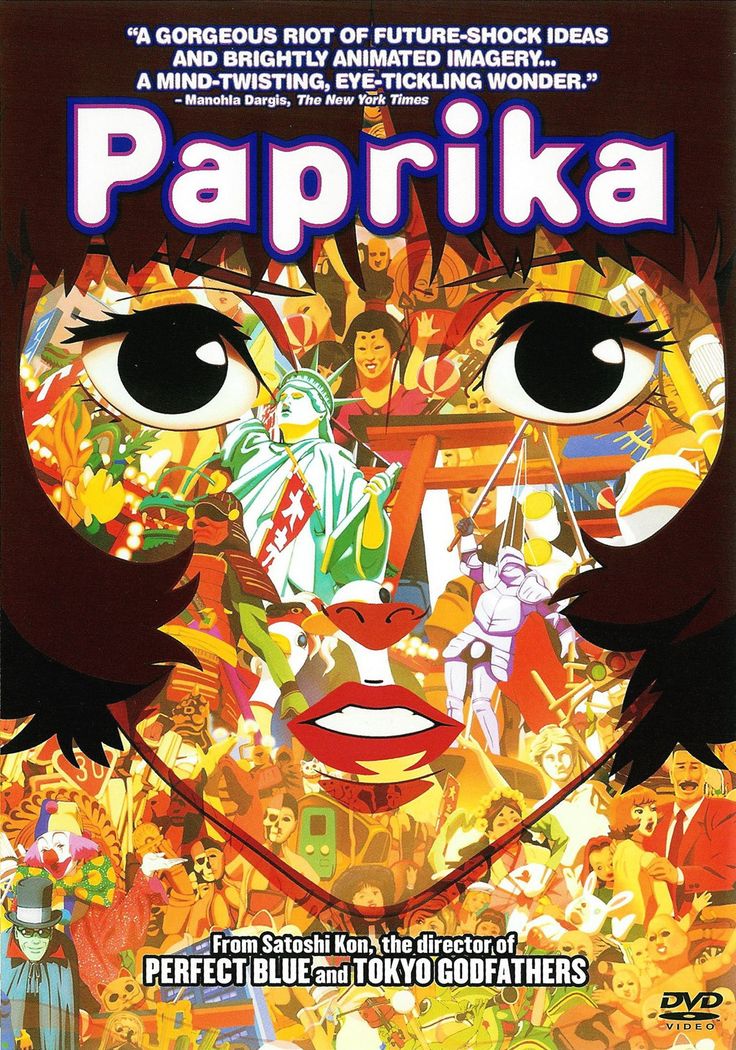
Fig. 1 Paprika (2006) Movie Poster/DVD Cover
 
 Satoshi Kon's Paprika (2006) is a Japenese animation that is based on Yasutaka Tsutsui's novel of the same name. It's story revolves around one device - The DC Mini. This device allows the user to look at someone else's dreams. When such device is stolen from, it is up to the Title character to retrieve it. Through it's complex narrative structure, it forces you to pay attention to everything that is happening, although it will still require another viewing to fully comprehend it.
 
Fig. 2 Paprika
 
 If you're familiar with Christopher Nolan's Inception (2010), then this film will be somewhat easier to understand. However, Paprika is so much more mind-bending and obscure than Inception could ever intend to be. Of course, the fact that it's an animation allows for the dream sequences to be so much more surreal, but even the meanings and structure of said sequences are a lot more unique. We are taken to many different scenarios, where the world is being broken write in front of our eyes. In some instances, they break down the film entirely and demonstrate the characters' knowledge of their existence in the film, as well as in their dreams.
 
Fig.3 Toshimi Konakawa
 
The Film's abstraction is pushed even further through the use of anime and the bright colours that are used. The key events are so magnificently observed and grab your attention instantly. Although there are some moments in which the animation feels a little still and stiff, it does an unbelievable job at creating such a high level of surrealism. Like an optical illusion, it twists and turns the World to it's own desire, with the characters trying to escape and understand it's obscurity.
 
Fig. 4 Parade

Due to the dream sequences, there are so many layers within the film's structure. It wants you to travel through them with the main characters and that is a phenomena in itself. It takes you on a journey which you shall not forget and will be dreaming about for some time.

Personally, I am not interested in Anime films, but Paprika is a magnificent film, with a revolutionary narrative, that makes me want to watch Inception.

Illustration List:
Fig. 1 Paprika (2006) Movie Poster/DVD Cover - https://s-media-cache-ak0.pinimg.com/736x/5c/9b/21/5c9b215c4b3b1cb16cc64590da7357c9.jpg - (Accessed 21/01/2016)
 
 
Fig.3 Toshimi Konakawa - http://media.animevice.com/uploads/0/3695/315109-paprika_14.jpg -  (Accessed 21/01/2016)
 

Thursday, 14 January 2016

Film Review: Mary & Max (2009)

Fig. 1 Mary & Max (2009) Movie Poster
 
Adam Elliot's Mary & Max (2009), in many ways, acts as an oxymoron. Although, at it's heart, it's quite a cute tale between two completely different people who find comfort in their communications, and with the film having some fun moments in, it does demonstrate some dark messages with some equally disturbing moments to match. These opposing components make for a fascinating experience, which you shall not forget in a hurry. 
 
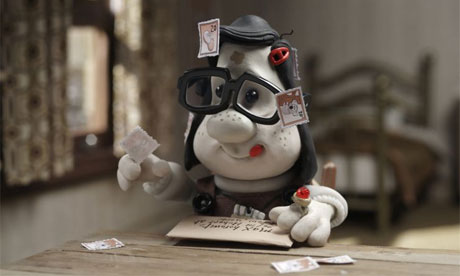
Fig. 2 Mary
 
As the title suggests, the film focuses on two characters - Mary and Max. We are introduced to Mary when she is still only a child - living in Mount Waverley, Australia. She is very lonely and has had/is having a troubling childhood, and with having no one to confide with, life is a very difficult for her. Max is a morbidly obese 44 year old Jewish man who lives in New York. There are certain parallels between his and Mary's life, as he too had a troubled childhood and finds living a difficult task. While living with anxiety attacks, his letters from Mary act as a way to forget about the world, as he gets pleasure from them.  As the story progresses, both characters develop through the years, but unfortunately for them, they progress in a negative manner. Mary grows ever increasingly concerned about her image and becomes depressed, as a result. Max's issues result in the diagnosis of having Asperger's disease. By the last few scenes of the film, the pair are linked through their troubles and this, therefore, makes their relationship easy to understand. 
 
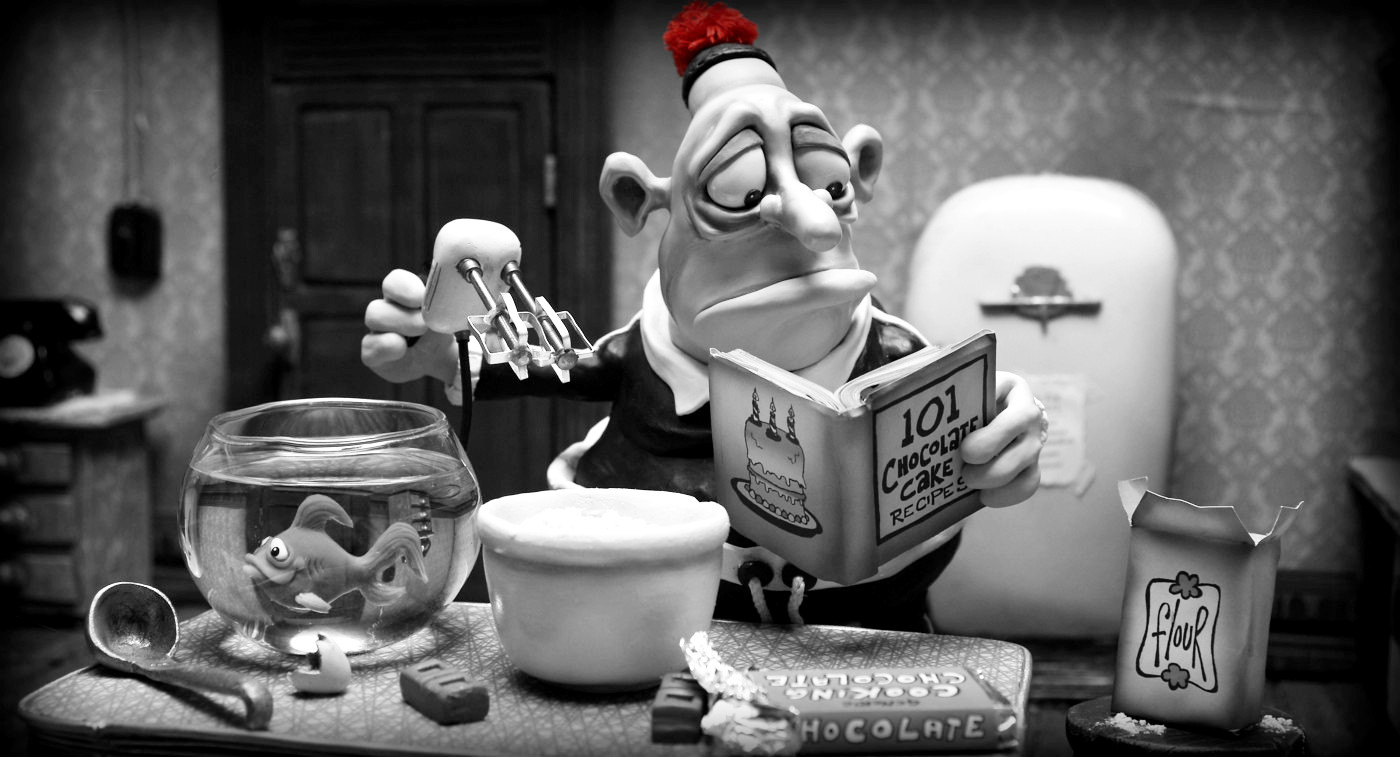
Fig. 3 Max
 
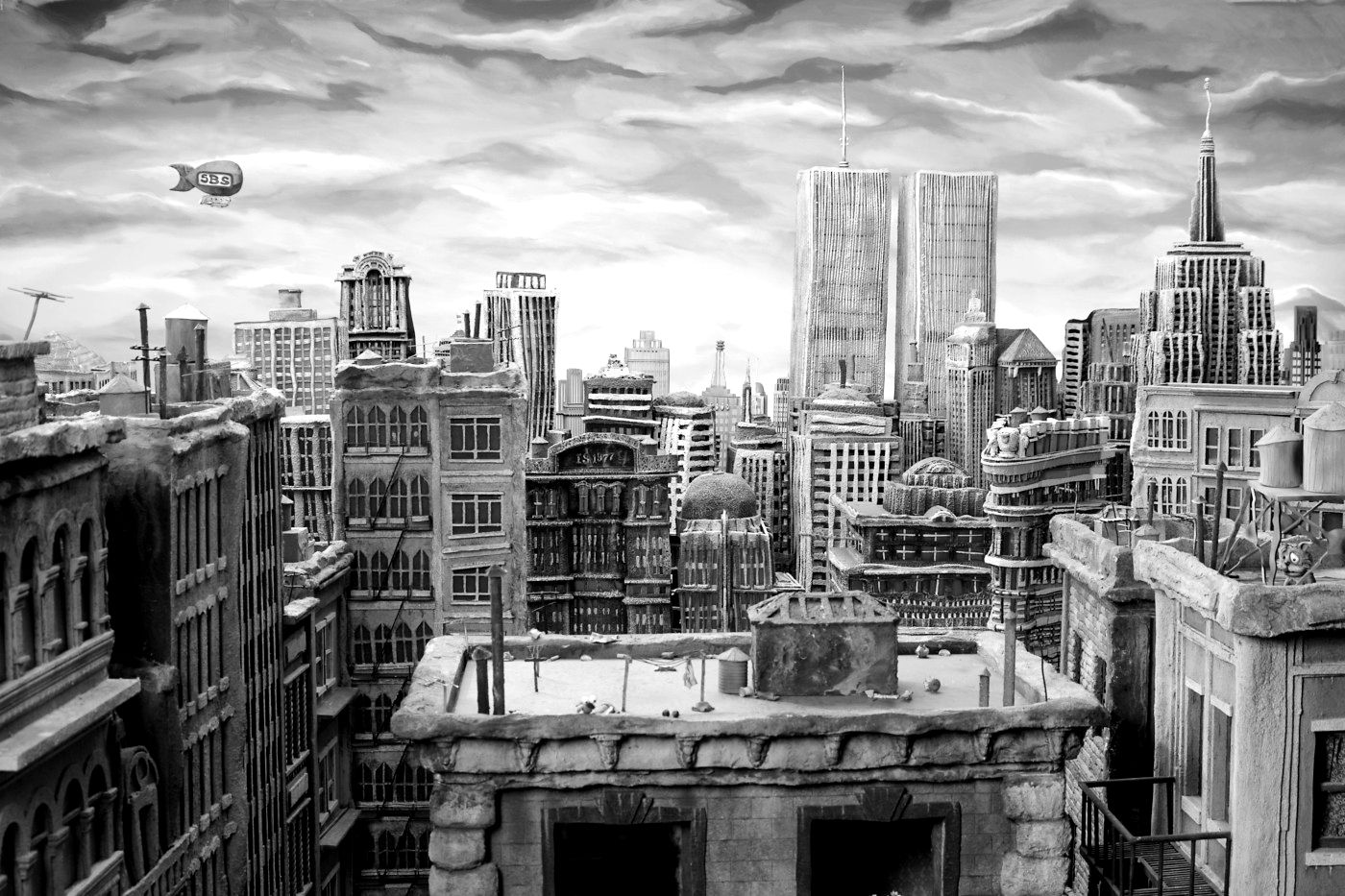
In this modern age of animations being computer generated, Mary & Max is a welcomed alternative through the use of Claymation (The use of clay figures and stop motion photography). With the film being set in the 1970s and 1980s, the film's animation style echoes back to the time of stop motion and the time before CG. Because of this, it makes the film's setting easy to understand and get a clear image of that time period. The clear lack of colour throughout highlights the dark tone of the film, with only a few objects being in full colour. The colour demonstrates the importance of certain objects in the film, and in some cases are there to show links between the two characters. Although, Mary and Max are miles a part, they still share a link and so the use of colour shows us this in a subtle, yet effective, way.

 
Fig. 4 New York City
 
It would be a fair argument to say that's it's a bit strange and unlikely that the characters' relationship would have come to fruition in the real world. As their interactions begin through Mary randomly chosing a name out of the phone box, and then it being someone like Max, then that is some what far-fetched. However, this suggests that the two were destined to share such a close bond and be similar in lifestyle and interests. This gives us the message that we can all grow a relationship with anyone.
 
In conclusion, the films has a fun sense of humor, all the while sharing some dark messages with some equally disturbing, and shocking, scenes. It tells the story of unlikely relationship, which will always make for a pleasant story - That is why I have given the film 4.5 / 5 stars.

 
Illustration List:
Fig. 1 Mary & Max (2009) Movie Poster - https://upload.wikimedia.org/wikipedia/en/8/8d/Mary_and_max_poster.jpg - (Accessed 14/01/2016)
 
 
Fig. 3 Max - http://www.aceshowbiz.com/images/still/mary_and_max16.jpg - (Accessed 14/01/2016)
 
Fig. 4 New York City - http://www.aceshowbiz.com/images/still/mary_and_max24.jpg - (Accessed 14/01/2016)

Friday, 8 January 2016

Film Reviews: Submission Post


Comedy & Laughter: Film Review - Airplane! (1980)

Fig. 1 Airplane ! (1980) Movie Poster

Airplane! (1980) is an American comedy that was written and directed by all three of Jim Abrahams, David Zucker and Jerry Zucker - The people behind "The Naked Gun" Franchise. Airplane! is regarded, by many, as one of the greatest film comedies of all time. Upon first viewing, it's humor lies in it's complete unpredictability. Often acting as a spoof of other film genres and disaster movies, Airplane! has turned into a true comedy classic.

Fig 2. Playing trumpets

Through the famous collaboration of the three Writers/Directors, we are also accompanied by Leslie Nelsen, who has starred in many of the Zucker, Zucker and Abrahams' films.Although he is by no means the main character, he offers some very memorable scenes and quotes to the film. Through it's extreme use of slapstick comedy, you simply don't know what's coming next. It uses visual comedy very regularly and so is quite easy to understand. If you're familiar with the style of American comedy, then this takes it to another level. In many ways, Airplane! breaks down the conventions of it's reality. As you can see in Fig. 3 a man is upside down, which is an obvious impossibility in those circumstances. It is very much aware of it's existence as fiction. In addition, to this the opening scene acts as a spoof of Steven Spielberg's film "Jaws" (1975), as we see the airplane flying through the sky as if it were a shark in the water. Another scene in the film, is when the main character Ted Striker (Played by Robert Hays_ is dancing in a bar, in the style of "Saturday Night Fever" (1977) - even while he's wearing the same clothing and the same iconic song is playing in the background. "Jaws" and "Saturday Night Fever" are very well known films, even now, and are of different genres, and this therefore demonstrates that film isn't afraid of mocking other films of other genres, and isn't concerned by their popularity.

Fig 3. Passengers

At it's heart, Airplane! could be considered as a Romance. The film's primary plot is Ted Striker's mission to get the girl, who he loves - Elaine Digerty (Played by Julie Hagerty). The film tells us about their past throughout the whole duration, and so when the "disaster" strikes and our hero is called to action, his main aim is to be with her again. As previously mentioned with regards to spoofs, the film's flashback sections are very cliche and so this contributed to the argument that the film is one big critique and pastiche of various genres and films.

For today's audience, this film will also demonstrate life and what was acceptable in films in the 1980s. There is one scene in particular where two black men are speaking to each other, who you can see in fig.3, and when they speak in a very obscure, but English, manner, we are giving subtitles. This would simply not be allowed in a modern film and so highlights how times have changed, with regards to racism in particular, in just over 35 years.

Fig. 4 "Boy's life" & "Nun's life"

It doesn't matter what your taste in comedy is, Airplane! has something in it that can make anyone laugh. Whether it's through the way it mocks other films or if it's just because of it's simple, yet effective, visual/slapstick comedy. Certain gags and punch lines of the film have cemented a place in cinema history, and could be a fair argument for being one of the best comedies. Airplane! will surely make you smile.

Illustration List:

 Fig 2. Playing trumpets - http://static.deathandtaxesmag.com/uploads/2015/02/airplane-zero-hour.jpg - (Accessed 08/01/2016)


Fig. 4 "Boy's life" & "Nun's life" - http://media-cache-ec0.pinimg.com/236x/7d/39/23/7d39238556fe9416f7c7694bc119a305.jpg - (Accessed 08/01/2016)

Tuesday, 24 November 2015

Adaptation: Film Review - Carrie (2013)

Fig. 1 Carrie (2013) Movie Poster

Kimberly Peirce's Carrie (2013) is the second film adaption of Stephen King's novel of the same name. This modern take on it's source material demonstrates Hollywood's lack of ideas and takes one it's most memorable and well regarded horror films, from 1976, into the 21st century cinema.

Fig. 2 Carrie (Played by Chloe Grace Moretz)

Chloe Grace Moretz plays Carrie in this film and so this is a much different choice of actress in comparison to the 1976 version, where Sissy Spacek played the lead role. She is an attractive actress and so her "weirdness" and obscurity is in her actions and how she speaks and dresses. Because of her appearance, though, it feels a little strange that she is segregated from everyone at her school and doesn't have anyone to protect her or talk to her. Despite this, it is clear that all is not as it seems with Carrie. It becomes clear in the film that her extremely religious Mother (Played by Julianne Moore) controls her and forces her to do what she wants. This consequently means that Carrie has to live with being abused, both mentally and physically, at home and at school.

Fig.3 Getting ready for the Prom

Effectively, this version is played out rather similar to the 1976 version, however as it is set in current times, the characters wear modern clothes and own modern things, such as iPhones. The famous locker room scene from the 1976 film is re-imagined through the other school students filming Carrie on their phones. This makes for a very sympathetic scene and highlights just how cruel the students can be. 


Fig.4 Carrie covered in Pig's blood

In conclusion, this is a very modern take on Stephen King's classic. It demonstrates the change between 1976 and 2013, this therefore highlights the difference in the challenges that Carrie faces in the two films. Although the overall plot structure is the same as the original version, it doesn't feel as convincing, however, due to the fact the wrong choice of actress (Chloe Grace Moretz) and the strange CG effects used in the final stages of the film.


Illustration List:
Fig. 1 Carrie (2013) Movie Poster - http://www.destroythebrain.com/wp-content/uploads/2013/10/carrie-domestic-poster.jpg - (Accessed 17/11/2015)

Fig. 2 Carrie (Played by Chloe Grace Moretz) - http://projectdeadpost.com/wp-content/uploads/2014/04/Carrie2.jpg - (Accessed 17/11/2015)

Fig.3 Getting ready for the Prom - https://c.o0bg.com/rf/image_460w/Boston/2011-2020/2013/10/10/BostonGlobe.com/ReceivedContent/Images/CARRIE-5693.jpg - (Accessed 17/11/2015)

Fig.4 Carrie covered in Pig's blood - https://i.ytimg.com/vi/7kYDXkO304o/maxresdefault.jpg - (Accessed 17/11/2015)


Friday, 23 October 2015

Opposing Characters: Film Review - Kill Bill: Volume 2 (2004)

Fig.1 Kill Bill: Volume 2 (2004) Movie Poster

Quentin Tarantino's Kill Bill: Volume 2 (2004) is a brilliant continuation of the story that we became so engaged with in the first film. Tarantino draws on influences from many kung fu movies, and in doing so creates a memorable conclusion to this tale. Roger Ebert said in his review that Kill Bill: Volume 2 is " an exuberant celebration of moviemaking, coasting with heedless joy from one audacious chapter to another, working as irony, working as satire, working as drama, working as pure action." - (Ebert,2004)

Fig.2 The Bride (Or Beatrix Kiddo [Played by Uma Thurman])

The film follows on directly from the last, but still allows new viewers to be aware of what is going on. It is clear that the Bride's mission is still intact as she continues to look for Bill and the remaining members of the Deadly Viper squad. If anything, she is even more determined to seek revenge for Bill destroying her life, and consequently her losing her daughter. Throughout the film, we learn more about the wedding and Bill and the Bride's past. It is because of this that we understand the Bride's feelings in more depth and why what happened at the wedding was so tragic. 

Fig.3 The Bride and Pai Mei (Played by Chia Hui Liu)

In quite a serious film, there are some rather ironic moments and bits of black comedy, which are obvious Tarantino trademarks. A particular chapter that provides the more comical moments is when we are shown a flashback to when Bill takes Beatrix Kiddo to Pai Mei, who was a master of Bak Mei and Eagle's Claw styles of Kung Fu. Pai Mei is a very serious character, one of whom that you wouldn't want to disagree with, but because of his constant flicking of his long white beard and subtle raising eyebrows, we can't help but laugh to ourselves. However, Pai Mei's skills are clear, and is reluctant to train Beatrix. It is only because of Bill that he gives her a chance. The training sequences are very reminiscent of Kung Fu films from the 1970s. We see Pai Mei balance on swords and have the most incredibly impossible reflexes. Beatrix is trying to learn one particular skill of being able to punch through wood from an open palm and without swinging. As we see her constantly fail, where Pai Mei succeeded in his first attempt, it is clear that she still has a lot to learn.

Once the flashback concludes and she escapes from the coffin that Budd (Played by Michael Madsen) had trapped her in, she is more reckless in her actions. She doesn't care what she must do to get to Bill, and once she gets past her other targets, she finally finds Bill, but all is not as she expected.  

Fig.4 Bill (Played by David Carradine)

In the final scenes of the film, Bill and Beatrix discuss their past, in a somewhat civillised matter. This is a to different to how she faced each individual member of the Deadly Viper Squad. Christy Lemire also notes this in her review by saying "If Kill Bill - Vol. 1 was like a roundhouse kick to the head, Vol. 2 is practically a warm hug." - (Lemire, 2012). This adds a bit more humanity to their relationship. In these scenes, Bill gives many memorable pieces of dialogue, one of which being a "review" of the character of Superman/ Clark Kent. This suggest that he is calling her a superhero, but unlike most superhero stories, it appears the villain, in this case it being Bill, will have the last laugh, metaphorically speaking. However, we then discover hat Beatrix had learned more from Pai Mei than we first thought.  During the two volumes, we are lead to believe that Bill is the stronger and more powerful one of the two characters, but due to the ending sequences it is becomes apparent that Beatrix is a lot stronger and more determined than we were lead to believe.


Illustration List:
Fig.1 Kill Bill: Volume 2 (2004) Movie Poster - http://images.moviepostershop.com/kill-bill-vol-2-movie-poster-2004-1020251862.jpg - (Accessed 23/10/2015)

Fig.2 The Bride (Or Beatrix Kiddo [Played by Uma Thurman]) - http://pmd205465tn.download.theplatform.com.edgesuite.net/Miramax/292/783/l5YTIwNjqg44KHQ0jdyeX7KitASKmcae_640x360_63419459930.jpg - (Accessed 23/10/2015)

Fig.3 The Bride and Pai Mei (Played by Chia Hui Liu) - https://oracleoffilm.files.wordpress.com/2013/11/kill-bill-4.jpg- (Accessed 23/10/2015)

Fig.4 Bill (Played by David Carradine) - https://blogger.googleusercontent.com/img/b/R29vZ2xl/AVvXsEjM0MqBnbh2sEPOhyphenhyphenN0_MJHPYmXoyDBu2sNi-GMbqjj8kb814kvfINGV_lrqYJX9UF1j8Gxj5Glpz4Pv2QqmtNsftMk0Ito3uBRaRIBHKOurJii-Us4_a7eiEKXlQaKSVDzNBFaNxnUcLiq/s1600/David+Carridine+Kill+Bill+Vol+2.PNG - (Accessed 23/10/2015)

Bibliography:
Ebert, Roger (2004) - Kill Bill, Volume 2 - http://www.rogerebert.com/reviews/kill-bill-volume-2-2004 - (Accessed 23/10/2015)

Lemire, Christy (2012) - Kill Bill: Volume 2 (2004) - http://www.rottentomatoes.com/m/kill_bill_volume_2/ - (Accessed 23/10/2015)

Friday, 9 October 2015

Plot Structure: Film Review - Mad Max: Fury Road (2015)

Fig.1 Mad Max: Fury Road (2015) Movie Poster

George Miller's Mad Max: Fury Road (2015) is a master piece in an age where Hollywood is receiving constant criticism for it's lack of fresh film ideas. This reboot/sequel may not have the most complex story, but it is one of the most thrilling and exhilarating films that you are ever likely to watch. Through Miller's incredible use of shots, and primary use of practical effects, it will keep your blood pumping throughout. 

Act 1 -Beginning:

The film takes no time to get right into the action. After a brief piece of dialogue from our main protagonist of Max Rockatansky (Played by Tom Hardy), we find the hero trying to escape the clutches of the Wasteland's inhabitants. Just from the very early scenes of the film, we get a clear understanding of the world and how it is run. It is clear that Max is broken by past, and so makes him vulnerable - This makes his capture inevitable. At this point, he is held prisoner by War Boys (Or Half-Lives) and their leader - Immortan Joe.

Fig.2 Opening shot

Act 2 - Middle:

The film then switches it's attention to who some would consider as the main character, despite the film title, in Imperator Furiosa (Played by Charlize Theron). It would appear that she is under Immortan Joe's command, as she must drive the war rig to Gas Town. However, on this journey, she diverts the Rig and the War Boys' cars. It is clear that she is not under Joe's control and has her own agenda. When Joe and the Citadel realise this, they get in their incredible cars. Each and every vehicle is designed so imaginatively. They are so unique and that is one of the many aspects that make both this film and franchise so remarkable. This marks the beginning of the main "chase" of the film. 

We then learn that Max is being used as a blood source as one of the War Boys, and so must be attached to the front of the car during the chase after Furiosa and the War Rig. In this sequence, we as an audience are treated to stop mayhem. With an amount of explosions that Michael Bay would be proud of, it takes nothing away from the brilliance in every shot and detail. Every individual frame of these scenes are a piece of art in their own right. It is such a pulse raising thing to watch. The soundtrack gets louder, the cars gets faster and more aggressive, and yet you dare not miss a moment of it. Perhaps the most exciting moments is when they're driving through a storm, that manages to grab the cars with ease and toss them through the air, while Max is trying to set himself free and stay alive. It is scenes like this that make the film so memorable and have such a lasting impact. 

Fig.3 Immortan Joe's Wives

When the storm settles, Max recovers and is forced to carry himself and the War Boy that he is supplying blood for - Nux (Played by Nicholas Hoult) to the War Rig, that has stopped in the distance. He intends to confront Furiosa and be free of Nux, although his plans appear to change when he finds a group of women using water and trying to get out of chains themselves. Furiosa is forced to set Max free due to him holding a gun to them. When she discovers Max also wants to take the War Rig, she is forced to stop him. When Nux awakes after being concussed from the storm, he assists Max, and helps him take the War Rig. Unfortunately for him, Furiosa has managed to create a sequence that must be triggered to drive it, and only she knows it, therefore forcing Max to allow Furiosa and the women into the Rig. Furiosa explains to Max that the women are Immortan Joe's Wives, and she is freeing from his clutches and is taking them to "The Green Place" where they can live in complete freedom. Max learns to understand their goal, despite his concerns of the Green place's existence. 

The pair continue to drive the Rig away from Immortan Joe and his followers in search of the Green Place and the Vuvalini of Many Mothers, who can help them. As the film progresses, they get more and more attention from the gangs that live in the Wasteland, which results in them trying to escape from the Warlords. In another equally as breathtaking scene of destruction of madness, one of the wives dies - Rosie Huntington-Whiteley's character called "Splendid". Sadly, she was heavily pregnant, consequently meaning the death of both her child and Immortan Joe's. This makes him even more aggressive, even more so when he discovers that it was a boy. It is apparent that Max and Furiosa must reach their destination. They continue to face many obstacles and challenges, but manage to overcome them all with little consequence. Furiosa stops the Rig in a place that appears familiar. They see a woman calling for help in the distance. Max believes that it's a trap, but this doesn't stop her from approaching the woman. As several motorbikes drive towards her, we find out that it's the Many Mothers. Furiosa is delighted. She knows the Green Place is near and they can help them find it. Her emotions change completely when they explain that they must have already past it - and they did. Furiosa is left heart broken, as it would seem they can not attain freedom.

Furiosa and the wives decide to go with Mothers on the motorbikes and to travel the Wasteland, leaving Max to live his life. Max is still haunted by his past and so has a change of heart. He drives after them, and tells them the best course of action would be to return to the Citadel. He explains that there's plenty of Water, greenery and is in no one's control due to Immortan Joe and the War Lords chasing after them. They agree to his plan, and so get back in the war rig and head towards the Citadel. One of the war boys spots them driving back, and so informs Joe of this, resulting in one more brilliant chase. This sequence appears to be a much harder task for them, due to the increased numbers of people following them. They manage to capture one of the wives and so are left having to save her, as well as trying to return to the Citadel first. Furiosa manages to throw herself onto Joe's car and defeats him in a brilliantly grotesque manner, however this comes at a cost as she get severely injured and is close to death. Nux, who is now driving war rig, sacrifices himself in order to save them. In doing so, he kills the warlords and the half-lives.  

Fig. 4 Furiosa (Played by Charlize Theron) and Max (Played by Tom Hardy)

Act 3 - End:

Max is left to try and save Furiosa from death, and uses his own blood to save her. They return to the Citadel, but the remainder of the injured War boys and young half-lives are left scratching their heads, as Max stops the car that previously belonged to Joe, he climbs on the bonnet and shows them Joe's body. The inhabitants of the Citadel rejoice as the leader who left them in the dirt is now gone and they can live a better life. Furiosa recovers and is shown helping people into the higher, and better areas, of the Citadel. The camera then cuts to Max walking through a crowd a people, therefore meaning that he intends to continue to roam the Wasteland alone.

Due to this ending it is left fairly open. Where will he go? What does he intend to do? Will we see Furiosa on screen again? Why didn't he stay with them? Does he wants to put his past behind him?

In conclusion, Mad Max: Fury Road demonstrates the effectiveness of practical effects and mainly female cast. This film passes the Bechdel test and acts as a pioneer for many upcoming action films. It highlights the strength and connection between a group of female characters, who do not need a man to survive.  At a run time of 2 hours, the film gets straight to the action and closes it quickly too. Act 2 dominates the length of this film, but due to it's sheer brilliance it quite rightly should do.

Apologies for any spoilers.


Illustration List:
Fig.1 Mad Max: Fury Road (2015) Movie Poster - http://cdn3-www.comingsoon.net/assets/uploads/gallery/mad-max-fury-road-1406144100/11110866_658246694280855_1682386295316885693_o.jpg - (Accessed 08/10/2015)

Fig.2 Opening shot - https://dariopecarov.files.wordpress.com/2015/05/d632b211_bb69cb62_madpietfurryroad5.jpeg - (Accessed 08/10/2015)

Fig.3 Immortan Joe's Wives - http://vignette2.wikia.nocookie.net/roadwarrior/images/6/6a/Wives.jpg/revision/latest?cb=20150522230054 - (Accessed 08/10/2015)

Fig. 4 Furiosa (Played by Charlize Theron) and Max (Played by Tom Hardy) - http://blogs-images.forbes.com/erikkain/files/2015/05/Max-and-Furiosa.png - (Accessed 08/10/2015)

Wednesday, 7 October 2015

The Hero's Journey: Archetypes - Seven (1995)

Fig. 1 Seven (1995) Movie Poster
 
Seven (1995) is David Fincher's second film, after Alien 3 (1992) . At the age of just 29, he managed to create one of Hollywood's most chilling and frightening crime thrillers. As a series of murders take place in accordance to the 7 deadly sins (Pride, Greed, Lust, Envy, Gluttony, Wrath and Sloth), it is up to Detective David Mills (Played by Brad Pitt) and Detective Lt. William Somerset (Played by Morgan Freeman) to find the killer.
 
The identity of our main hero could be argued. Is it David Mills - The new, and young, recruit who is eager to adapt to the new city and it's challenges? Or is it William Somerset - Full of experience and is close to retiring? At first, Somerset is to reluctant to take Mills into his ranks, and avoids letting him in on all the details of the case, and in some instances makes him look very inexperienced. It is because of this that Somerset could be regarded as the shadow character. The reason for this is that as the plot progresses and he learns more about Mills and his life, he finally treats him with respect, and in doing so growing a strong relationship with him. 
 
Fig.2 David Mills (Played by Brad Pitt)
 
One of the people who helped Somerset to show some appreciation towards to Mills is Mills' wife, Tracy Mills (Played by Gwyneth Paltrow). She helps Mills with his problems, both at his work and with his relationship with Somerset. It is only when the three have a dinner together when they start to bond and continue with the case in a more productive manner. Through Tracy Mills' contribution, she allows them to work together properly and it makes them put their troubles/differences behind them. She also provides more realism to the film, as she creates the more light hearted moments, as the three characters discuss the new living situation of that David and Tracy share. 
 
When they're working, Somerset uses his wisdom and experience to help Mills. He acts as his guardian. He gives him a greater knowledge of society, the people and how the police work in the city. While Mills is working in correspondence with new ideas and techniques, Somerset takes it back to the basics of going to the library, and doing research the old fashioned way.
 
Fig.3 Detective Lt. William Somerset (Played by Morgan Freeman)
 
Like any Murder mystery film, or TV show for that matter, the true identity of the killer is unknown. However, unlike most  of other films of the genre, we only fully see the killer for the first time 90 minutes in, which is remarkable considering the film's run time is 128 minutes. John Doe (Played by Kevin Spacey) is a calm, quiet and emotionless character, and that is what makes him so terrifying and such a brilliant villain. He is convinced that his actions will stand the length of time. He plans out every small detail to incredible lengths - removing his finger prints on a regular basis, for example. What makes Kevin Spacey's performance so great is that he has so little screen time in comparison to the other main characters, but it is he who creates the biggest impact. He steals every scene that he is in. It is clear that his plan is working, and so this contributes to one of the most shocking film endings ever to hit the screen.
 
Fig. 4 John Doe (Played by Kevin Spacey)
 
The cast of Seven is relatively small. With only 4 key characters, and the rest only playing minor roles, the common film archetypes are shared between the main 4. This demonstrates how films do not need a big cast of characters to be a hit. Through it's dramatic ending, the film is a very rare example where the Villain gets the last laugh.
 
Illustration List:
 
Fig.2 David Mills (Played by Brad Pitt) - https://thesouloftheplot.files.wordpress.com/2013/04/whatsinthebooox_se7en.jpg - (Accessed 07/10/2015)
 
Fig.3 Detective Lt. William Somerset (Played by Morgan Freeman) - http://www.thelistlove.com/10-facts-you-dont-know-about-seven/8-57/ - (Accessed 07/10/2015)
 
Fig. 4 John Doe (Played by Kevin Spacey) - http://i1.tietuku.com/7ca88a8503699922s.jpg - (Accessed 07/10/2015)


Thursday, 24 September 2015

The Hero's Journey: Fight Club (1999)

Fig. 1 Fight Club (1999) Movie poster

For this "The Hero's Journey" task, I thought I'd try to identify the steps in one of my favourite films: David Fincher's Fight Club (1999). The film itself is quite complex and confusing, and so it doesn't, necessarily, have a main hero character, like Marty McFly in Back to the Future (1985). Also, the way it critique's modern day culture (or at least the culture in the late 90s), this film could be beneficial and referred to when writing my postmodernism essay, through the way it mocks the way we live, what we buy and what we eat.

The way I'll show these steps is by writing out the plot in quite some depth and then taking parts out of what I have wrote and then putting the steps in a list

SPOILERS AHEAD!

For the majority of the film, Edward Norton's character does not have a name that we know of. He uses different names when going to AA meetings of different kinds. At this stage, we refer to Edward Norton's character as "The Narrator", as we don't know his real name. He doesn't have much interaction with any character in particular. However, in the early stages of the film, we meet Marla Singer (Played by Helena Bonham Carter). At this point in the film, there isn't any clear sign of affection towards her, and is in fact the opposite. Despite this, her appearances at the AA meetings aggravate him and so she is controlling his actions to some degree. 

Fig.2 "The Narrator" played by Edward Norton -The "Hero"

While on a plan journey, he meets Tyler Durden (played by Brad Pitt). There are some similarities between both characters, but Tyler appears to be a lot more confident in his actions. When "The Narrator" is returning home to his apartment, it has been burned down. He then decides to ring Tyler in a phone booth, but there is no answer, so he hangs up the phone. Suddenly, the phone starts ringing, he answers and it's Tyler - They arrange to meet up. During this meeting, "The Narrator" is reluctant to ask if he could stay at Tyler's place. It is only when Tyler forces him to ask does he then ask the question. When they leave the bar, Tyler wants him to get into a fight, which he eventually does. This leads to a gathering of people watching them. As they continue to have these fights, the pair organise a fight club underneath a bar, where people can fight each other while following their rules.
Fig.3 Tyler Durden (Played by Brad Pitt)

Due to the success of the Fight club, it develops into organised crime, known as Project Mayhem. The members of this project have to complete many difficult and controversial tasks, such as destroying sculptures, having fights with random people and breaking into shops. Tyler is clearly in control, and "The Narrator" remains confused, and wants answers. Tyler then appears to go missing, leaving him in control of the whole operation. The members of this project are still under the influence of Tyler, as they don't listen to him in the same way. 

Fig.4 Marla Singer played by Helena Bonham Carter - The "Goddess"

As "The Narrator" wants his questions answered he goes off in search for Tyler, but he realises that Tyler's influence is wider than he thought, as there appears to be similar fight clubs all over the country. He then meets this man, who claims that he has been Tyler Durden all along, and so meaning Brad Pitt's character didn't exist. He refuses to believe the man, and so rings Marla, asking her what his name is. She is confused before shouting out and repeating his name of Tyler Durden. He realises he needs to stop Project Mayhem as they intend to destroy several buildings in the city. He finds one of the sets of bombs in a building, then suddenly Tyler Durden (Brad Pitt) appears in front of him. He tries to irritate him and wants him to stop trying to stop what he put together, but does still assist him, to some level, when defusing the bomb. The two have a fight. The CCTV cameras show us that when he fights Tyler, he is just fighting himself. Tyler holds a gun to him. He then has a moment to think and realises that the gun is actually in his hand. He manages to kill Tyler by shooting into his mouth. He now realises who he really is, and so is both the man he thought he was an Tyler Durden. Marla is taken to him by members of Project Mayhem. He reassures Marla that he is fine, and that she just met him at a very strange time in his life. 

The Hero's Journey Steps:

The Call to Adventure: When "The Narrator" is returning home to his apartment, it has been burned down. He then decides to ring Tyler in a phone booth, but there is no answer, so he hangs up the phone. Suddenly, the phone starts ringing, he answers and it's Tyler - They arrange to meet up

The Refusal of the Call:  "The Narrator" is reluctant to ask if he could stay at Tyler's place. It is only when Tyler forces him to ask does he then ask the question.

Supernatural Aid: While on a plan journey, he meets Tyler Durden (played by Brad Pitt). There are some similarities between both characters, but Tyler appears to be a lot more confident in his actions.

Crossing the Threshold: When they leave the bar, Tyler wants him to get into a fight, which he eventually does. This leads to a gathering of people watching them.

The Belly of the Whale: As they continue to have these fights, the pair organise a fight club underneath a bar, where people can fight each other while following their rules.

Road of Trials: Due to the success of the Fight club, it develops into organised crime, known as Project Mayhem. 

Meeting the Goddess: However, in the early stages of the film, we meet Marla Singer (Played by Helena Bonham Carter).

Woman as Temptress: her appearances at the AA meetings aggravate him and so she is controlling his actions to some degree.

Atonement of Father:  Tyler then appears to go missing, leaving him in control of the whole operation. The members of this project are still under the influence of Tyler, as they don't listen to him in the same way.

Apotheosis (God-like): Tyler is clearly in control, and "The Narrator" remains confused, and wants answers.

The Ultimate Boon: He then meets this man, who claims that he has been Tyler Durden all along, and so meaning Brad Pitt's character didn't exist

Refusal of Return: He refuses to believe the man, and so rings Marla, asking her what his name is. She is confused before shouting out and repeating his name of Tyler Durden. 

Magic Flight: He realises he needs to stop Project Mayhem as they intend to destroy several buildings in the city. He finds one of the sets of bombs in a building, then suddenly Tyler Durden (Brad Pitt) appears in front of him.

Rescue from Without: He tries to irritate him and wants him to stop trying to stop what he put together, but does still assist him, to some level, when defusing the bomb.

Crossing the Return Threshold: Tyler holds a gun to him. He then has a moment to think and realises that the gun is actually in his hand. He manages to kill Tyler by shooting into his mouth.

Master of Two Worlds: He now realises who he really is, and so is both the man he thought he was an Tyler Durden

Freedom to Live: He reassures Marla that he is fine, and that she just met him at a very strange time in his life. 


Illustration List:
Fig. 1 Fight Club (1999) Movie poster - http://i.jeded.com/i/fight-club.25541.jpg - (Accessed 24/09/2015)

Fig.2 "The Narrator" played by Edward Norton -The "Hero" - http://www.magiclanternfilmsociety.org/wp-content/uploads/2013/07/fight-club_1999-3-1920x1200_scroller.jpg - (Accessed 24/09/2015)

Fig.3 Tyler Durden (Played by Brad Pitt) - http://www.washingtonpost.com/blogs/reliable-source/files/2014/10/FightClubPitt.jpg - (Accessed 24/09/2015)

Fig.4 Marla Singer played by Helena Bonham Carter - The "Goddess" - http://rob.conery.io/wp-content/uploads/2011/01/marla2.png - (Accessed 24/09/2015)


Tuesday, 28 April 2015

Film Review - The Blair Witch Project (1999)

Fig.1 The Blair Witch Project (1999) Movie Poster

Eduardo Sanchez and Daniel Myrick's The Blair Witch Project (1999) is a chilling pioneer for found footage films. It would be a fair argument that the film is one of the main reasons behind the growth and success in independent films. Unlike the great Horror films, there is no "monster" to be seen, but we sure do believe that there is one. Christy Lemire talks about the film's difference to other horror films in her review by saying that "The thought that Blair Witch Project just might be real makes it much scarier than any of the teen horror flicks that have stumbled along in recent years." - (Lemire, 2013)

Fig.2 Josh Leonard (Left) & Mike Williams (Right)

As the title says, the film is based on three students who are making a project about the Blair Witch. Arguably, it plays out similar to that of Hitchcock film, as it is some time into the film when all the tension is created, so it, therefore makes us wait. We expect things in the early scenes, which do not happen, and so we become afraid of things without them taking place. That is an incredible thing to say as it is remarkable how just three students with a camera can create such fear. In early scenes of the film, when we meet secondary characters, we are made aware of the belief that the Blair Witch may or may not exist in the woods. The characters appear un-convinced, as are we.

Fig.3 Heather Donahue

Perhaps, where the film succeeds the most is through the characters and their relationship. Heather Donahue is seen as the main character, which in itself is remarkable, but brilliant. In earlier films, we would expect one of the male characters to be the leader, but this choice demonstrates her desire to make the film, where as Josh Leonard and Mike Williams seem not as interested. As she is the "leader", the way her feelings progress in the film affect the other characters. As she becomes even more terrified, we see the characters start to disagree and argue with each other. They become scared of something that they have no proof of existing. The shaky camera shots highlight how the film is changing. Where as in the earlier scenes, we had steady and focused camera shots, we now start to see close ups and the shot being at an angle. Joe Morgenstern also talks about the camera shots in his review: "The scariest shots, from someone's little Hi-8 camcorder, document the students losing their bearings, giving way to panic and finally falling victim, though off screen, to some ineffably, unphotographably evil presence." - (Morgenstern, 2013). This proves that their desire to learn about the "Witch" has escaped and so now want to escape the "Witch".

Fig.4 The Woods

The Blair Witch Project has a simple idea with a simple method of film making, but is one of the greatest, and most memorable, horror films in recent years. It makes us terrified without showing us anything, but through the dramatic use of camera angles and terrified expressions of the characters, we start to believe in what is not seen. Roger Ebert refers to this in his review of the film that ""The Blair Witch Project" is a reminder that what really scares us is the stuff we can't see." - (Ebert,1999). It truly redefined found footage films and has lead to the surge in independent films in the last decade. 

Illustration List:
Fig.1 The Blair Witch Project (1999) Movie Poster - http://upload.wikimedia.org/wikipedia/en/2/26/Blair_Witch_Project.jpg - (Accessed 28/04/2015)

Fig.2 Josh Leonard (Left) & Mike Williams (Right) - https://comedicallywitty.files.wordpress.com/2013/10/blair-witch-project-2.jpg - (Accessed 28/04/2015)

Fig.3 Heather Donahue - http://cdn.bloody-disgusting.com/wp-content/uploads/2014/10/Screen-Shot-2014-10-15-at-9.25.14-PM-620x400.png - (Accessed 28/04/2015)

Fig.4 The Woods - https://filmfork-cdn.s3.amazonaws.com/content/blairwitch.png - (Accessed 28/04/2015)

Bibliography:
Ebert, Roger (1999) - The Blair Witch Project - http://www.rogerebert.com/reviews/the-blair-witch-project-1999 - (Accessed 28/04/2015)

Lemire, Christy (2013) -  The Blair Witch Project (1999) - http://www.rottentomatoes.com/m/blair_witch_project/ - (Accessed 28/04/2015)

Morgenstern, Joe (2013) - The Blair Witch Project (1999) - http://www.rottentomatoes.com/m/blair_witch_project/ - (Accessed 28/04/2015)

Sunday, 26 April 2015

Film Review - Reservoir Dogs (1992)

Fig.1 Reservoir Dogs (1992) Movie Poster

Quentin Tarantino's Reservoir Dogs (1992) is a thrilling film debut for one of today's greatest directors.  David Nusair refers to it being Tarantino's first film by saying that it is "one of the most impressive debut features in cinematic history." - (Nusair, 2014). The dialogue driven story is something we are now accustomed to from Tarantino and gives us a glimpse of what he is capable of. Through dramatic shots and an iconic soundtrack, Reservoir Dogs is a film that you will not forget in a hurry. 

Fig.2 Mr. Pink (Left) and Mr. White (Right)

In a similar sense to Alfred Hitchcock's Rope (1948), the film plays out in one setting, for the most part. The dirty and gloomy interior matches the tone of the film incredibly. It provides the perfect backdrop to some of Tarantino's finest moments in his brilliant career. It is fascinating to see how the characters develop within the walls of the warehouse. After the opening scene that shows the characters' strong, yet sometimes mysterious, connections with each other, we see them fall apart after their planned robbery goes horribly wrong. Tarantino uses a series of flashbacks that show us the, what you could say, "origin" of the character's inclusion into the heist. As arguments and disagreements progress, the film becomes even more tense as we do not know the consequences of the characters' actions. Tarantino's clever use of camera angles add to the suspense magnificently. 

Fig.3 Mr. Blonde (Played by Michael Madsen)

What is perhaps the film's best, yet most controversial, scene is when Mr. Blonde (Played by Michael Madsen) is torturing a police man. Tarantino places the camera behind the police man, which therefore makes us watch Mr. Blonde walk around the room, while planning what he is going to do. This, therefore, makes for a very tense scene as it gives us the police man's perspective, which makes us aware of horrified he must be. It is, however, when Mr. Blonde cuts the police man's ear off, when we get a different camera angle and are in fact shown a section of the wall, leaving us to hear the act take place. This is a very horrific sequence, but Tarantino still manages to produce one of Hollywood's most well known scenes. Gary Thompson describes this scene in his review: "While a radio plays a bad song from an FM ''Sounds of the '70s" retrospective (a running joke here), Mr. Blonde begins dancing, singing and brandishing his implements of torture - a razor, a can of gasoline, a lighter. He then begins to mutilate his victim." - (Thompson,1992). As Thompson correctly identifies, the soundtrack is very important in this scene. "The Sounds of the 70s" play out frequently throughout the film, but the upbeat music being played alongside Mr. Blonde's comical dance style gives the scene a weird feel that makes you not take it too seriously. That is something that is very strange due to the seriousness of Mr. Blonde's actions.

Fig.4 Mr. Blonde, Mr. White & Mr. Pink

Reservoir Dogs lays the foundations for all of Tarantino's great films. The controversial and non-linear storyline is a technique that Tarantino is known for, but due to the relationships between the characters it is something we can relate to, to some extent. Jeff Dawson says in his review that "Reservoir Dogs has all the hallmarks of a modern classic." -(Dawson, 2006)

Illustration List:
Fig.1 Reservoir Dogs (1992) Movie Poster - https://cinefilles.files.wordpress.com/2012/12/reservoir-dogs-poster.jpg - (Accessed 26/04/2015)

Fig.2 Mr. Pink (Left) and Mr. White (Right) - http://keyassets.timeincuk.net/inspirewp/live/wp-content/uploads/sites/28/2012/04/resdogs.jpg - (Accessed 26/04/2015)

Fig.3 Mr. Blonde (Played by Michael Madsen) - http://ilarge.lisimg.com/image/1523962/1118full-reservoir-dogs-screenshot.jpg - (Accessed 26/04/2015)

Fig.4 Mr. Blonde, Mr. White & Mr. Pink - https://blogger.googleusercontent.com/img/b/R29vZ2xl/AVvXsEgUsifGJjHTgKU9AjGeEjKMPkQ2XrnL8so9zsje4vevabm5giFTV0-uLtHLSRx5N3VNHkSVashDgCwFKPVNv5FQB9BGJ_LNH1EbMvauiTHiTGzytBrDmyRX5NMpoE2ukEe5qgwURDeEO7ZY/s1600/Reservoir+dogs.png - (Accessed 26/04/2015) 

Bibliography:

Dawson, Jeff (2006) - Reservoir Dogs - http://www.empireonline.com/reviews/reviewcomplete.asp?DVDID=6455&page=2 - (Accessed 26/04/2015) 

Nusair, David (2014) - The Films of Quentin Tarantino - http://reelfilm.com/tarantin.htm#res - (Accessed 26/04/2015) 

Thompson, Gary (1992) - Going For The Jugular 'Reservoir Dogs' A Cut Above The Usual Actioner
  -http://articles.philly.com/1992-10-30/news/25998760_1_informant-andrzej-sekula-fake-names - (Accessed 26/04/2015)